

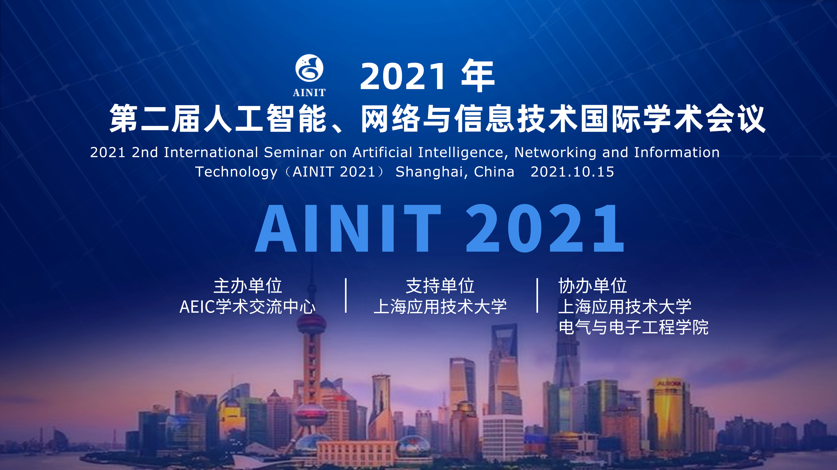
2021 2nd International Seminar on Artificial Intelligence, Networking and Information Technology (AINIT 2021) has successfully held on October 15-17, 2021. About 150 participants attend.There were about 200 delegates from 15 countries (China, USA, Japan, South Korea, Pakistan, Canada, Germany, Macau (China), France, Portugal, Saudi Arabia, Turkey, Singapore, Vietnam, Australia) that attended the online conference, several experts in related fields were invited to give keynote speeches. The in-depth discussions among the attendees effectively advanced the academic exchange. Conference proceedings published by IEEE CS Conference Publishing Services.
![CRL0JHR{USOIKIA]_FF_FYA.png](../ueditor/php/upload/image/20211022/1634888059775222.png "1634888059775222.png")
The 2021 2nd International Seminar on Artificial Intelligence, Networking and Information Technology (AINIT 2021) is to bring together innovative academics, industrial experts, engineers, students and practitioners working all around the world to promote scientific information interchange in the field of AI, network and information technology and their applications. The sponsor is Shanghai Institute of Technology and AEIC-Academic Exchange International Center.
AINIT 2021 includes inviting keynote speeches, oral presentations and poster presentations of refereed papers. The conference has provided networking opportunities for participants to share ideas, designs, and experiences on the state-of-the-art and future direction of AI, network and information technology. AINIT 2021 will feature a high-quality technical & experiential program dealing with a mix of traditional and contemporary hot topics in paper presentations and high-profile keynotes.
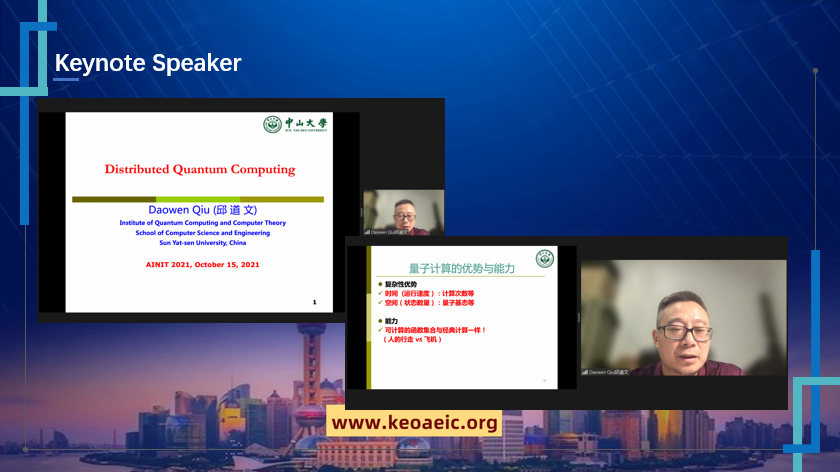
The first speaker is Prof. Daowen Qiu, from Sun Yan-sen University, his speech title is Distributed Quantum Computing. Dr. Qiu and his team have published over 130 papers in peer-review journals, and over 25 conferences papers. More specifically, (1) they have systematically studied a number of different QFA (quantum finite automata) models, and solved the decidability of equivalence and minimization of these QFA models. Therefore, they have answered the problems of how to decide the equivalence of quantum sequential machines proposed by Professor Gudder, and how to decide the equivalence of MM-1QFA proposed by Professor Gruska. In particular, they have answered the problems of how to minimize QFAs proposed by Moore and Crutchfield. Also, they have studied some properties of 2QFAC, quantum pushdown automata, and quantum Turing machines. (2) They have proved the characterization of all Boolean functions that can be solved by quantum 1-query algorithm. (3) They have studied quantum states discrimination and quantum cloning machines, and they have derived some bounds on unambiguous discrimination and minimum-error discrimination (some bounds are optimal to a certain extent), and some relationships between unambiguous discrimination and minimum-error discrimination have been clarified. Also, they have established a generic machine model of probabilistic cloning and deleting, and proposed a universal probabilistic deleting machine. (4) They have studied quantum teleportation and superdence coding based on different entangled states (W-states). (5) They have studied semi-quantum cryptography and proved that a semi-quantum key distribution protocol is unconditional security. (6) They have discovered some essential connections between quantum logic and models of computation, and they have established residuated lattice-valued automata theory. (6) They have established a fundamental framework of the supervisory control for fuzzy discrete event systems (FDES).
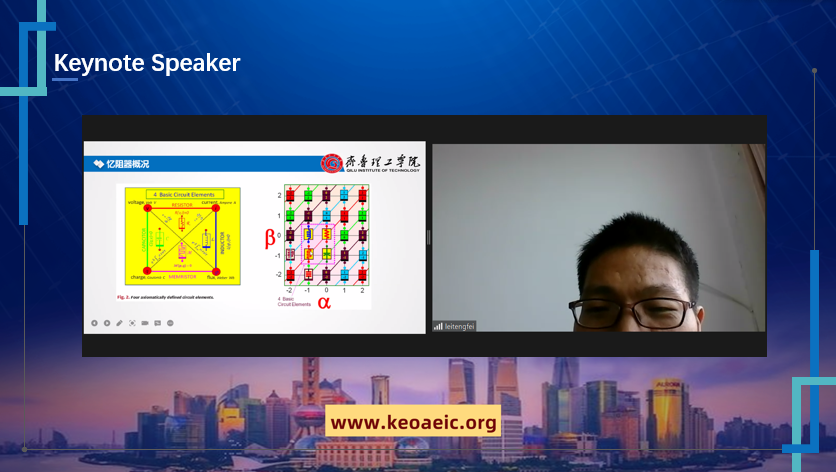
The second speaker is Prof. Tengfei Lei, from Qilu Institute of Technology, his speech title is Dynamic Analysis and Circuit Design of Memristive Chaotic System. Dr. Lei is a CPC member, Associate Professor, Ph.D. and graduate supervisor at Tongji University. Lei is currently the Deputy Dean of School of Electric Engineering at Qilu Institute of Technology, a committee member of Shandong Automation Society, Deputy Director of Electronics Education Committee of Shandong, a member of Committee of Chaos and Nonlinear Circuits Association of China Electronics Society, an executive director of the Strategic Alliance of Robotics and Intelligent Manufacturing Industry, member of the Committee of Shandong Electronics and Communication Standardization Committee, a Senior Member of China Power Supply Society. Lei’s major research interests cover memristance computing and application, analysis and control of fractional nonlinear systems, power switching technology for aerospace equipment. He has authored 96 research papers and one textbook; he also owns 20 patents, among which 4 are inventive patents, and possesses two software copyrights.
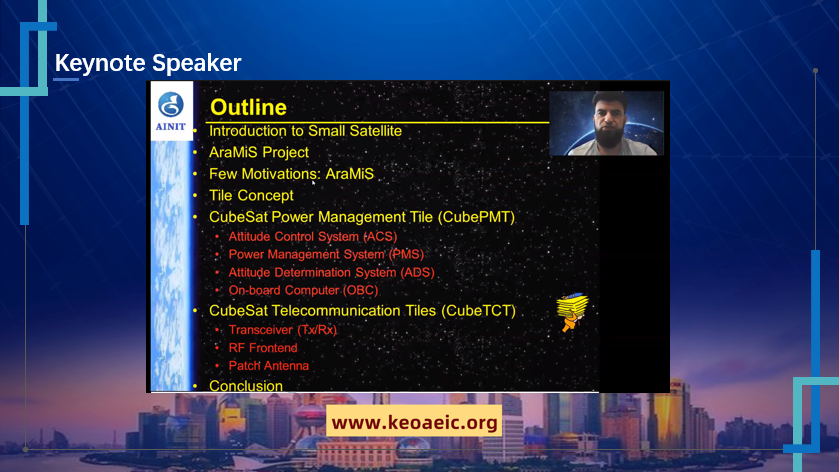
The third speaker is Dr. Anwar Ali, from Zhejiang Sci-Tech University, his speech title is Design and Development of a Small Satellite Subsystems-AraMiS-C1. The main point of his speech: The nanosatellite market is rapidly growing for scientific and commercial applications. The main reason is the availability of low-cost commercial-off-the-shelf (COTS) components and already-developed subsystems in the market. This evolution also enabled many universities and small & medium-sized enterprises (SMEs) to develop their own satellites. The problem with small satellites is the available space and weight constraints for housing a large number of required subsystems, such as power, attitude determination and control, telecommunication, and payload. The ultimate solution is to make all subsystems smaller, lighter, and cost effective. In this conference we are going to discuss the subsystems of a small satellite with CubeSat dimension called AraMiS-C1 and specifically power management, attitude determination & attitude control, and telecommunication subsystems. The power management, attitude determination & attitude control subsystems were developed on a single PCB with CubeSat dimensions called CubePMT tile while the telecommunication subsystems (transceivers, RF frontend and antenna) were developed on another CubeSat dimensions PCB called CubeTCT tile. The complete AraMiS-C1 satellite has four CubePMT and two CubeTCT tiles on the external six faces. The developed AraMiS-C1 satellite is light in weight, has lower cost, most of the subsystems is reconfigurable and has a large space inside the cube for payload.
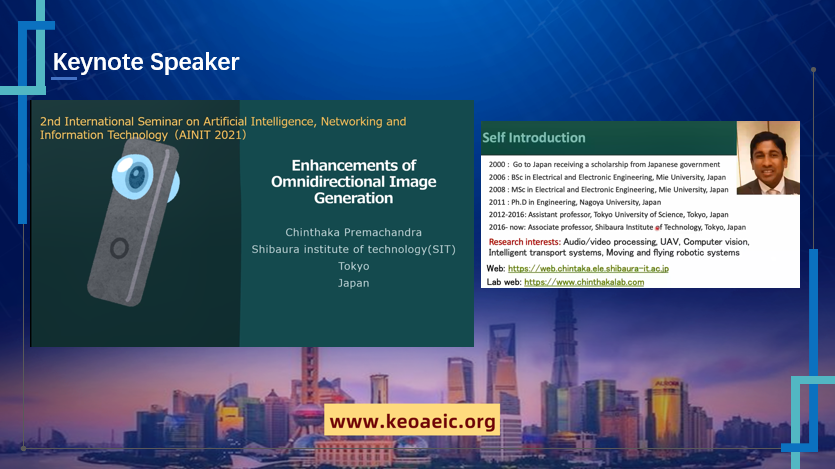
The forth speaker is Dr. Chinthaka Premachandra , from Zhejiang Sci-Tech University, his speech title is Enhancements of Omnidirectional Image Generation. From 2012 to 2015, he was an Assistant Professor with the Department of Electrical Engineering, Faculty of Engineering, Tokyo University of Science, Tokyo, Japan. From 2016 to 2017, he was an Assistant Professor with the Department of Electronic Engineering, School of Engineering, Shibaura Institute of Technology, Tokyo. In 2018, he was promoted to an Associate Professor with the Department of Electronic Engineering, School of Engineering/Graduate School of Engineering and Science, Shibaura Institute of Technology, where he is currently the Manager of the Image Processing and Robotic Laboratory. His laboratory conducts research in two main fields: image processing and robotics. The former field includes AI, computer vision, pattern recognition, image processing, and camera-based intelligent transportation systems, while the latter field includes mobile robotics, aerial robotics, and integration of terrestrial robot and aerial robot.
The Best Oral Presentations
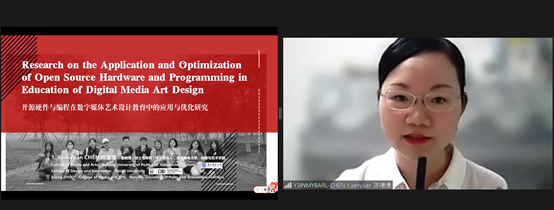
Reporter: Dr. Yuanyuan Chen (A. Prof)
College of Media Art, Nanjing University of Posts and Telecommunications
Title:Research on the Application and Optimization of Open Source Hardware and Programming in Education of Digital Media Art Design
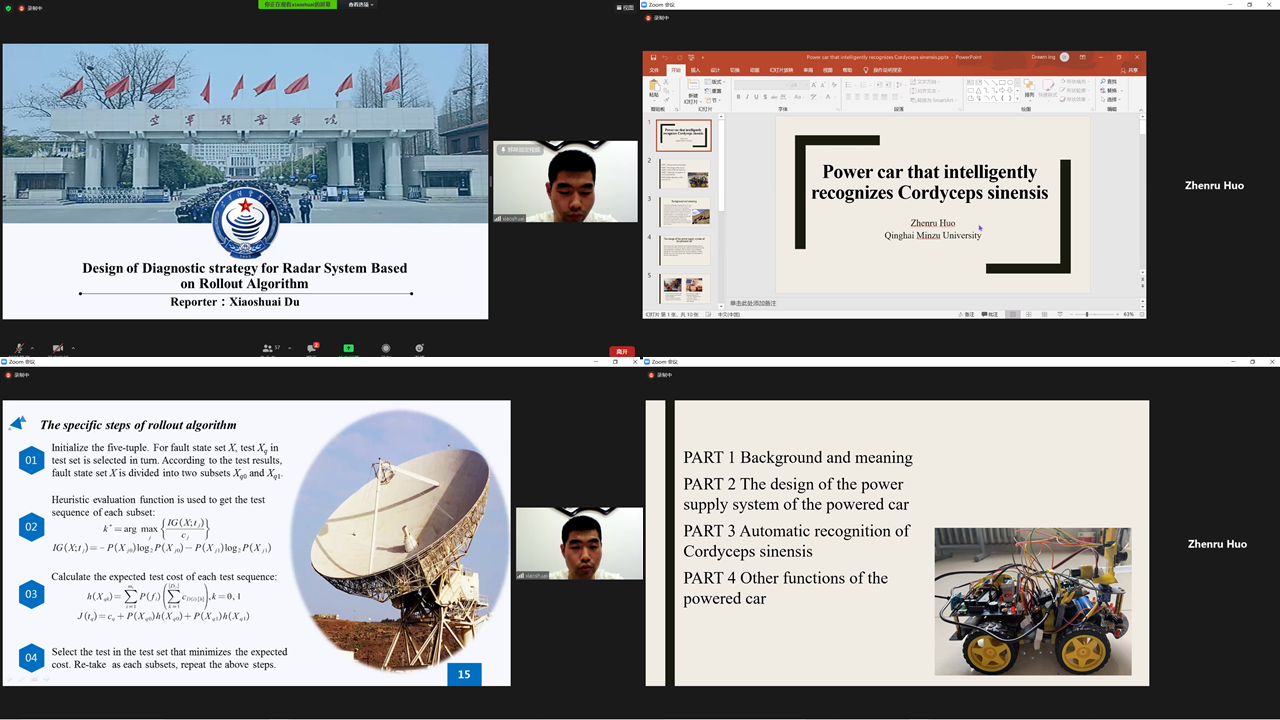
Reporter: Dr. Zeyuan Li
Donghua University
Title:Discriminative-Transformer for Emotion Classification